Introduction – Ten Years in the Driver’s Seat
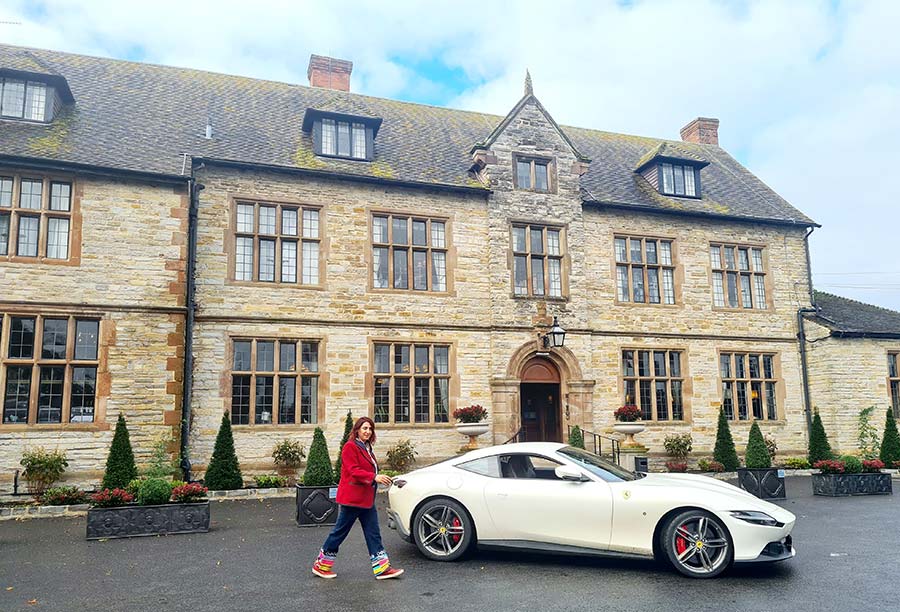
For over a decade, I have reviewed Ferraris in the UK for MenStyleFashion. I’ve driven them in conditions that would make most drivers nervous — from the calm sun of summer country lanes to torrential British storms. I’ve brought my readers not just the glamour shots, but the real experience of living with these machines.
Yet in 2025, something has changed. Ferrari UK no longer invites me to press launches, no longer asks me to review their latest cars, and no longer features women like me on their social media.
It reminds me of Lewis Hamilton’s recent confession: “I feel like a bit of a useless person.
”In his case, it was about being underused despite being one of the most talented drivers on the grid. In mine, it’s about being ignored despite years of proven results. The parallel is hard to miss.
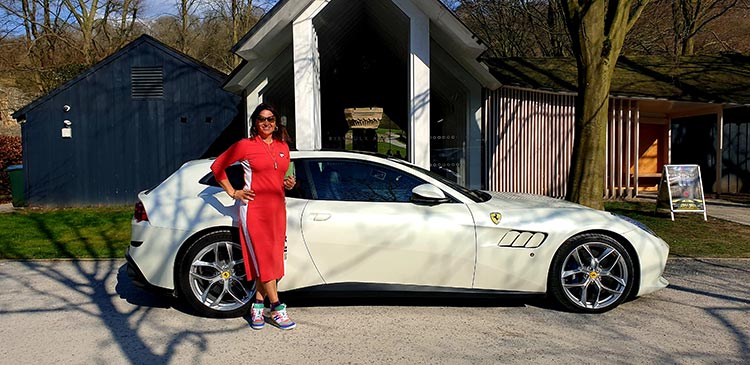
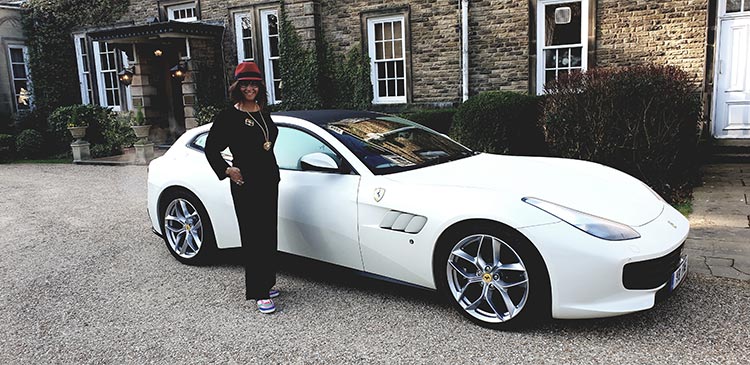
There was no parking space so the Abbey allowed me to park
The Missing Demographic in Ferrari’s UK Marketing
Scroll through Ferrari UK’s Instagram or TikTok, and a pattern emerges. The female presence is almost exclusively young. Often beautiful, always photogenic — but never representing the millions of women over 50 who not only drive but buy and love Ferraris.
It’s a curious oversight, because the reality of luxury car ownership tells a very different story. The average age of a Ferrari buyer is not 25. It’s not even 35. Most owners are in their late 40s, 50s, and 60s — people who have spent years building careers or businesses and now want the joy of a supercar in their garage.
So why is this demographic absent from Ferrari UK’s media presence?
Is It Engagement, Age, or Image Control?
When I’ve asked about the shift, the answers have been vague. In one exchange, I was told to “contact Ferrari Italy” for media access — despite all my Ferrari coverage always being UK-focused and UK-published. Ferrari Italy, unsurprisingly, refused to help.
Was I being politely fogged off? It certainly felt like it. The question is why.
Is it about engagement numbers? My audience may not match the viral spikes of some 21-year-old influencers, but MenStyleFashion has built a loyal readership over a decade. That’s influence — the kind you can’t fake.
Is it my age? I’m over 50, confident behind the wheel of a 200mph machine, and unafraid to say what I think. I don’t fit the pliable, made-for-Instagram mould.
Or am I, in Ferrari UK’s eyes, like Hamilton — “a bit of a useless person” — overlooked despite experience, results, and the ability to perform at the highest level?
The Paradox of Ferrari’s Marketing Strategy
Ferrari is a brand built on legacy. The prancing horse represents craftsmanship, engineering excellence, and timeless style. Yet in their UK social media, the human faces of that legacy seem almost entirely under 30.
This isn’t unique to Ferrari. The luxury automotive industry has long lagged behind fashion and beauty when it comes to confronting ageism. While brands like Dior and L’Oréal have embraced older ambassadors, car brands still behave as though only the young can be aspirational.
The irony? Many of Ferrari’s most loyal customers, the ones who’ve owned multiple models over decades, are exactly the people they now choose not to show.
What Women Over 50 Bring to the Wheel
A woman over 50 behind the wheel of a Ferrari is not just a driver — she’s a statement. She’s a business owner who can afford the car herself. She’s someone who has navigated life’s twists and turns with as much control as she now handles a hairpin bend. She’s someone younger women look up to because she made it — and she’s not apologising for it.
Representation matters. When women over 50 see themselves reflected in luxury branding, it validates their place in the conversation. When they don’t, the message is clear: you’ve aged out of the fantasy.
But the fantasy doesn’t end at 30. If anything, for many women, that’s when it begins.
Engagement Isn’t Just Likes
Let’s talk about engagement. Brands often hide behind the excuse that younger influencers “perform better” online. But what does that really mean?
Sure, a video of a 23-year-old in a Ferrari might rack up quick likes on TikTok. But my readers — many in the position to actually buy a Ferrari — don’t just like. They read. They share. They talk about the review over dinner with friends. They bookmark it because they’re genuinely considering a purchase.
Influence is not measured solely by double-taps. It’s measured by the ability to convert curiosity into action. And in that respect, seasoned voices matter.
My History with Ferrari UK
This isn’t coming from someone on the outside. I’ve worked with Ferrari UK for years. I’ve reviewed their models, attended their events, and shared my experience with an audience they cannot otherwise reach.
The feedback from my readers has always been the same: they appreciate a woman’s perspective on a car world still dominated by male voices. They value seeing someone who doesn’t just model next to the car, but truly drives it.
To go from that to radio silence is more than just disappointing — it’s a reminder of how easily women in this industry can be replaced when they no longer fit a narrow visual ideal.
Is the UK Press Office Afraid of the Question?
When I raised the lack of older women in their media, the response wasn’t to address the question but to pass me along to Italy — knowing full well it would lead nowhere. It’s a classic PR deflection.
But here’s the truth: avoiding the conversation only makes the issue louder. Ferrari UK’s social media feeds tell a story of glamour, speed, and beauty. But they could tell a richer story — one that includes women of all ages enjoying the thrill of driving a Ferrari.
The Bigger Picture – Ageism in Supercars
The automotive world prides itself on breaking boundaries — in speed, design, and technology. Yet socially, it’s stuck in the slow lane.
Just as brands once had to confront the lack of female drivers in their marketing, now they need to confront the lack of older women. Because until they do, the message to women over 50 remains: You can buy the car. You can love the car. But don’t expect to see yourself in the picture.
And if Ferrari UK continues to ignore that, more women like me will start to feel — in Hamilton’s words — “a bit of a useless person” in a conversation we helped build.
A Call to Ferrari UK
Ferrari UK, you know my track record. You know my readership. You know I can tell your story to a demographic you currently ignore.
This isn’t about me demanding a press invite — it’s about asking why your social media doesn’t reflect the reality of your audience. And it’s about challenging an industry to stop treating age as a liability.
The prancing horse is a symbol of power and elegance. It’s time for your marketing to show that those qualities are ageless.
Conclusion – The Road Ahead
After ten years of working with Ferrari UK, I deserve an honest answer. Is it my engagement? My age? Or simply that my face doesn’t fit the curated grid of your Instagram?
Whatever the reason, the conversation about women over 50 in supercar marketing is one that won’t go away. Because as long as we are absent from the picture, we will keep asking: If we can buy the car, why can’t we be seen driving it?
Or, to borrow from Hamilton one last time — if we’re this experienced and this committed, yet still kept on the sidelines, then maybe we are, in the eyes of the UK press office, “a bit of a useless person.”