
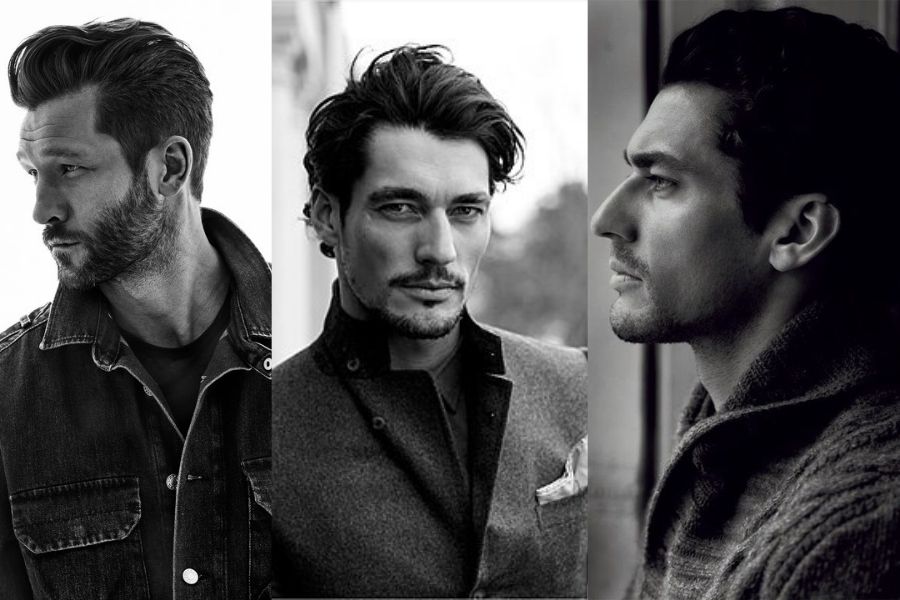
I launched MenStyleFashion in 2012. My first interview was with David Gandy at London Collections: Men in 2013. Since then I’ve interviewed Ricki Hall, John Halls, Andres Velencoso, and dozens of other male models, designers, and stylists across fashion weeks in London, Milan, Florence, Barcelona, and New York. Our photographer Maria Scard’s images from these events have been featured in Vogue. I am known in the industry as the female voice for menswear.
London Collections: Men, January 2013. My very first fashion week interview. The man standing in front of me: David Gandy.
I’d prepared questions about menswear trends. About whether runway styles translated to the street. About Dolce & Gabbana. I forgot all of them. Because up close, Gandy’s face did something photographs had never conveyed. Those blue eyes — and I’d seen them in a hundred campaign images — were a different experience at arm’s length. Sharper. More alive. He held eye contact while talking to me, even with Maria Scard and a dozen other photographers jockeying for his attention behind us, and that single quality gave his face a dimension the camera never captures.
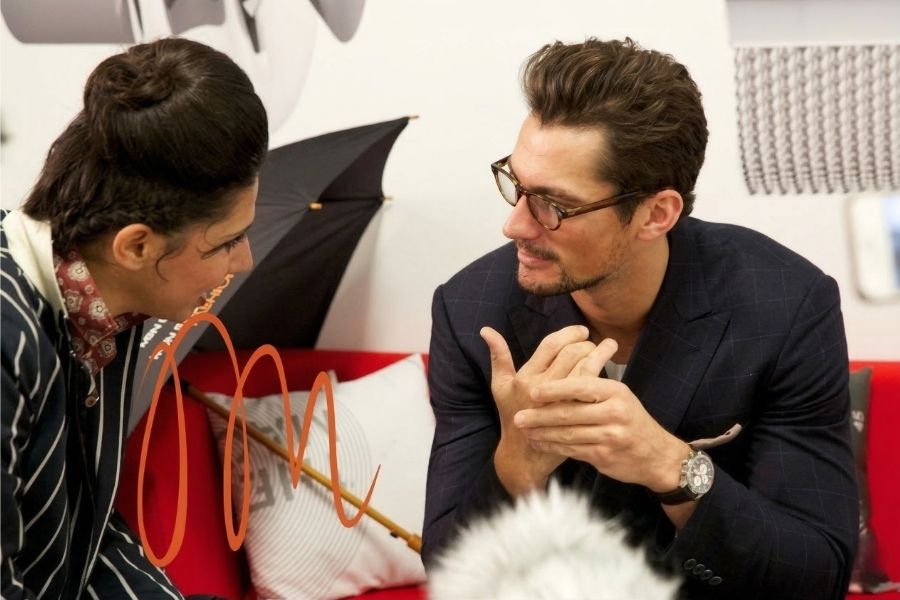
I asked him how he handled being constantly photographed. His answer, verbatim: “It’s my job.” Three words. No ego. No performance. He said it the way a plumber might say he fixes pipes. That plainness, combined with his awareness of every camera angle in the room, told me something about facial attractiveness that I’ve spent 12 years confirming: the most attractive thing a face can do is look present without looking like it’s trying.
That interview changed MenStyleFashion. It changed how I approach men’s faces. And it gave me a decade-long obsession with a question the academic research only half-answers: what is it about certain men’s faces that makes women turn around?
Ricki Hall: Every Rule About Male Facial Attractiveness, Broken
In August 2013, five months after that first Gandy interview, I sat down with Ricki Hall.
Ricki is not David Gandy. He’s not classically handsome by any clinical measure. Full beard. Covered in tattoos. He was scouted walking out of a Topman store in London — not at a modelling agency, not at a casting. A scout saw something in his face on a random Saturday afternoon and handed him a card for Nevs, his agency. From that point, Ricki became one of the most influential male style icons of 2013 and 2014, booked constantly, and known across the industry alongside tattooed models like Ash Stymest and Jimmy Q.

I interviewed him about his look, his tattoos, his beard maintenance. But the conversation I remember most was about how women responded to him versus how the fashion industry expected women to respond to him. Ricki told me that when he walked into castings, some clients didn’t know what to do with him. He wasn’t clean-cut. He didn’t fit the Gandy mould. But when he appeared at events, women gravitated toward him — because his face had character. Personality. A lived-in quality that a symmetrical, groomed model’s face often doesn’t.
The Association for Psychological Science (referencing the Stirrat & Perrett study on fWHR) published research showing women associate wider male faces with dominance and short-term dating interest. That research is conducted with photographs in controlled settings. It measures one variable at a time. Ricki Hall’s career is what happens when you add the other 50 variables back in: movement, voice, the way a beard frames an imperfect jaw, the way tattoos draw the eye across a face that isn’t symmetrical but is undeniably compelling.
Ricki taught me that the research on facial attractiveness tells you what wins in a photograph. It doesn’t tell you what wins in a room.
Read my original 2013 breakout interview with Ricki Hall on the rise of the “Bearded Icon.”
John Halls at Barcelona Fashion Week: The Smile That Ended the Conversation
Barcelona Fashion Week, March 2015. John Halls, a British male model, had just walked for Desigual.
I spotted him in the crowd afterwards. He wasn’t the tallest man there. Wasn’t the most chiselled. But his smile — wide, genuine, directed at whoever he was talking to — made it impossible to look elsewhere. I shouted across to him to give me a smile for the camera. He walked over, kissed me on the cheek, and said, “I know who you are.”

What struck me in person was that John’s entire face changed when he smiled. Not a model smile — the kind where the mouth moves but the forehead stays frozen. Everything moved. Eyes narrowed. Cheeks lifted. The geometry of his face shifted from ordinary to magnetic. A study in the Journal of Comparative Psychology by Little et al. found that facial symmetry is one of the strongest cross-cultural predictors of perceived attractiveness. John’s face wasn’t remarkably symmetrical at rest. But when he smiled, everything balanced. The expression itself created the symmetry the research says we’re drawn to.
John also told me he’d been a professional footballer before modelling. He carried himself like an athlete — relaxed, physical, comfortable in his body. That ease translated directly to how his face read. No tension. No self-consciousness. His face looked like it belonged to someone who wasn’t worried about how his face looked.
I’ve photographed dozens of men at fashion weeks who had better bone structure than John Halls. None of them commanded a room the way he did. His face was proof that expression and energy outweigh architecture.
Read our full John Halls interview to learn more about the athlete-to-model transition.
What Our Photographer Maria Scard Taught Me About Shooting Men’s Faces
Maria Scard has been MenStyleFashion’s photographer since the beginning. Her images of David Gandy at London Collections: Men were picked up by Vogue — not because she had the most expensive equipment in the room, but because she understood something about men’s faces that most fashion photographers ignore.
Maria’s method: never ask a man to pose. Shoot him mid-sentence. Mid-laugh. Walking. Turning. Her philosophy is that a man’s face at its most attractive is his face at its most unguarded. The second he knows the camera is there and arranges his expression, something dies in the image.
I watched this play out hundreds of times. At London Fashion Week in 2015, Maria and I worked the crowd outside the shows. Our approach was simple — I’d walk up to a man and say, “I’m from MenStyleFashion, can I take a photo?” The men who looked best on camera were the ones who kept talking, kept laughing, and forgot Maria was there within seconds. The men who stiffened up, sucked in their cheeks, and tilted their jawlines toward the lens? Consistently flat. Lifeless. No matter how handsome they were.
Maria once told me the difference between a face that photographs well and a face that’s attractive in person: “The camera loves movement. A face that’s frozen is a face that’s dead.” She said Gandy understood this instinctively — even when he was being photographed by 20 people simultaneously, he never locked into a single expression. He shifted constantly. A slight smile. A glance left. A raised eyebrow. Each micro-movement gave every photographer a different image.
That’s not something the attractiveness research measures. Symmetry, jaw width, facial proportions — all measured from static images. Maria’s career is built on the opposite insight: that attractive faces are attractive because they move.
The Day David Gandy Put On Persol Glasses and Changed His Entire Face
London Collections: Men, June 2013. Second day. Gandy arrived wearing a vest, grey tie, a white shirt, Paul Smith and Ralph Lauren pieces, and a pair of Persol frames.
I noticed the glasses before I noticed the outfit. Because they did something to his face I hadn’t seen before. Gandy’s bare face reads as powerful. Strong jaw, intense eyes, slightly intimidating. The Persol frames softened all of that. They added an intellectual quality, a warmth, that his unframed face doesn’t naturally project. Women at the event that day used words like “smart” and “sophisticated” to describe him — not the usual “gorgeous” or “intimidating.” One pair of frames moved him from one category of attractiveness to a completely different one.

A study from the College of Optometrists found that glasses increase perceived trustworthiness and intelligence. But the finding I care about as someone in men’s fashion is geometric. The right frame shape adds structure where the face doesn’t provide it.
Knowing your face shape helps here. The five main categories—oval, round, square, heart, rectangular—each pair differently with different frame styles. Walking the halls of the Fortezza da Basso at Pitti Uomo in 2026, I’ve noticed a distinct shift toward stronger rectangular and square frames. It’s a ‘return to masculinity’ that mirrors the structured tailoring we’re seeing from Prada and Zegna this season. If you don’t know yours, ask your barber. They evaluate face shapes constantly.
What Women at Fashion Events Told Me They Actually Notice
Over 12 years of attending fashion weeks, after-parties, brand presentations, and industry dinners, I’ve had this conversation with women more times than I can count. Not formally. Not as a survey. Just the natural question that comes up when you spend your career photographing handsome men: what do you actually notice?
The answers, distilled from years of these conversations:
-
Eyes and eye contact Mentioned more than anything else, by a wide margin. Not eye colour — eye behaviour. Whether a man looked at them or past them. Whether the attention felt genuine. A stylist I spoke with at Pitti Uomo once told me: “A man with average features who holds proper eye contact will always beat a gorgeous man looking at his phone.” I’ve never heard a woman disagree with that.
-
Smile Specifically: real smiles. The John Halls effect. Women can tell the difference between a performative smile and one that reaches the eyes. I’ve watched it happen at events in real time — a man with an unremarkable face lights up with a genuine smile and suddenly he’s the one people drift toward.
-
Grooming Not perfection. Evidence of care. Clean skin. Shaped facial hair. Maintained eyebrows. Multiple women over the years have specifically mentioned uneven or wild eyebrows as something they notice negatively. The backstage grooming teams at fashion shows know this — eyebrow shaping is one of the first things they do, because even a millimetre of adjustment changes how balanced a face appears.
-
Expression and energy How animated the face is. Whether the man looks tense or at ease. This echoes exactly what Maria Scard photographs for. The Pitti Uomo observation holds: a relaxed, expressive face on an average-looking man draws more attention than a tense, bored face on a handsome one.
-
Jawline and bone structure It appeared. Fifth. Behind eyes, smile, grooming, and expressiveness. The feature the internet fixates on most ranked last in 12 years of my informal, unstructured conversations with real women at real events.
Where the Research Lines Up and Where It Misses
The academic work on facial attractiveness is not wrong. Symmetry does matter — women I spoke with describe it without naming it, saying a face “just works” or “nothing looks off.” Composite “average” faces (a finding dating back to 1878 and replicated many times) do rate higher than extreme faces — which means most men are closer to attractive than they believe. Wider faces do read as more dominant in controlled settings.
Where the research loses accuracy is in its method. Static photographs. Isolated variables. Controlled lighting. Zero context. A face in a lab is not a face at a dinner table, or in a bar, or walking through the Fortezza da Basso in a well-cut linen suit. Ricki Hall’s career would not exist if facial attractiveness worked the way lab studies suggest. John Halls’ smile would be irrelevant. Gandy’s Persol frames would make no difference.
Real faces move. They express. They’re framed by hair, beards, glasses, clothing. They exist in three dimensions, not two. The research gives you the baseline. Twelve years of watching women respond to men’s faces in real life gives you everything the baseline leaves out.
Frequently Asked Questions
What facial feature do women find most attractive on a man? Eyes and eye contact, based on 12 years of conversations at fashion events. In laboratory research, symmetry and jawlines score highest. In person, expression and grooming matter more than bone structure.
Does face shape affect how attractive a man is? No single face shape is more attractive than another. Face shape determines which hairstyles, beard shapes, and glasses frames create the most balanced appearance — and that grooming alignment does affect attractiveness.
Can glasses make a man more attractive? Research says yes — glasses increase perceived intelligence and trustworthiness. From personal observation at fashion events, the right frames can also shift a man’s entire perceived personality, as I witnessed when David Gandy wore Persol frames and the descriptors women used for him changed from “gorgeous” to “sophisticated.”
Do women prefer beards or clean-shaven faces? Research from the Journal of Evolutionary Biology found heavy stubble rated highest on average. Preferences vary between individuals. The consistent finding: well-maintained facial hair outperforms both patchy beards and neglected clean-shaven looks.