
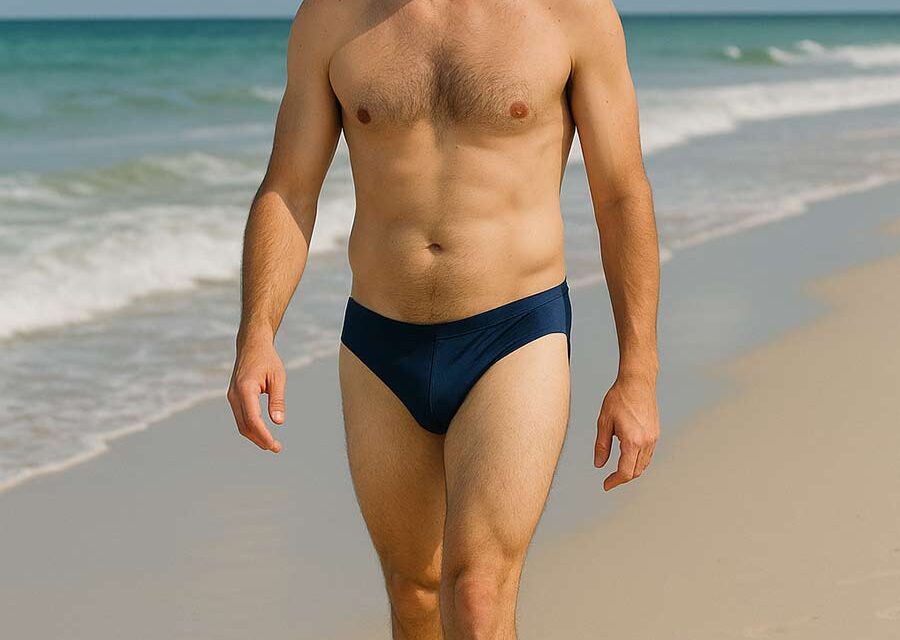
There’s a funny double standard playing out on beaches around the world.
Women in G-strings, Brazilian cuts, and cheeky bikinis? Totally normal now in many places. Whole bums out, tan lines on display, Instagram ready.
Men in anything that shows even half a butt cheek? Suddenly it’s “too much,” “attention-seeking,” or “inappropriate.” A guy in a Speedo is still a talking point, and a man in a thong is treated like a social experiment. Even AI refuses to give me an image of a man with buttocks on the beach.
So what’s going on here? Why are we so used to female buttocks on the beach but not male ones – and what would you actually do if you saw a man confidently walking along the shore in a G-string?
Let’s unpack the debate.

1. The Beach Dress Code: Written Nowhere, Enforced Everywhere
There is no official global beach dress code, yet everyone knows there is one.
- Women can wear:
- Full one-piece
- Bikini
- Cheeky bottoms
- G-string / thong
And most people barely blink anymore, especially in Europe, Latin America, or party islands.
- Men are “supposed to” wear:
- Board shorts
- Swim shorts
- At most, a Speedo if he’s swimming seriously, racing, or if it’s a very European vibe.
But a thong? A G-string? That’s where the invisible rule suddenly slaps down: too far, mate.
The unwritten rule is simple: women’s bodies are “supposed” to be on display; men’s are “supposed” to be covered, strong, but not sexualised.

2. The Female Body Is Normalised as Decoration
For decades, swimwear brands, magazines, and advertising have sold the idea that women’s bodies are the scenery of the beach.
Sun loungers, cocktails, yachts… and a woman’s bum in a tiny bikini bottom. That’s the postcard.
When women wear thong bikinis, people might judge, envy, admire, or scroll right past – but they’re used to the image. It lives in every campaign, music video and resort promo. Female buttocks have been turned into beach wallpaper.
Men’s buttocks? Rarely shown unless it’s comedy, a joke, or something “edgy.” Men are allowed to be topless, muscular, powerful – but not overtly sensual in the same way. Their bodies are framed as functional, not decorative.
So when a man wears something ultra-revealing, he steps outside this script. He’s no longer just “a guy swimming”; he becomes a sexual or provocative object. And that makes people uncomfortable, because it flips the usual power dynamic.

3. Masculinity, Vulnerability and the Fear of Being Ridiculed
A woman in a G-string may get judgment – but she’ll also get compliments, desire, and Instagram likes.
A man in a G-string, though? He risks being laughed at.
- “What on earth is he wearing?”
- “Who does he think he is?”
- “Is he trying to get attention?”
We’ve built a version of masculinity that says: be strong, be confident, but don’t be too vain, too flamboyant, or too sexual. If you are, people humiliate you.
Most men know this instinctively. That’s why they stick to safe swim shorts even if secretly they’d love the freedom of less fabric, fewer wet clingy trunks, and an even tan.
Underneath the joke is something sad: we’re fine objectifying women, but we shame men when they dare to step into the same spotlight.

4. The “Respect the Families” Argument
Another classic line: “But what about the children? There are families on the beach.”
This is interesting, because the same families often have no issue with women’s buttocks hanging out of bikinis. The rule subtly becomes:
- Female bum: playfully sexy, slightly naughty but accepted
- Male bum: too explicit, uncomfortable, inappropriate
It’s not really about skin; it’s about who is “allowed” to be sexual in public.
When we say men must cover up “for the children,” we’re actually revealing our own discomfort with male sensuality. Children don’t come pre-programmed with shock; adults teach them what’s “normal” and what’s “wrong.”
If cheeks are okay on one gender, why are they scandalous on the other?
5. What Would You Do if You Saw a Man in a G-String on the Beach?
Be honest: your first reaction would probably be notice. You’d look. You might glance twice. You might roll your eyes or you might think, “Good for him.”
But let’s break it down.
1. The Shock Phase
You’re not used to it, so your brain screams: “This is unusual.” Maybe you laugh, maybe you feel second-hand embarrassment, maybe you feel curious.
2. The Projection Phase
Your mind starts creating a story about him.
- “He must love himself.”
- “He must be European.”
- “He must be gay.”
- “He’s confident as hell.”
All assumptions, none of which you actually know.

3. The Choice Phase
Here’s the real debate: what do you do with that moment?
You have options:
- Judge: mock him, whisper to your friends, secretly take photos (which is not okay).
- Ignore: accept it as just another human in swimwear and get back to your book.
- Admire: not necessarily physically, but admire the confidence. That kind of comfort in your own body is rare.
What you choose says more about you than about his swimwear.
6. Men’s Body Freedom: Is It Really That Radical?
Women have fought for decades to wear what they want on beaches: bikinis were once considered scandalous. Today, thong bikinis are standard in many places.
We forget that every bit of “normal” body freedom we see today once started as rebellion.
Maybe men wearing more revealing swimwear is just the next frontier of body acceptance:
- Men feeling comfortable in their bodies at every age and size.
- Men not only being allowed to be “strong,” but also beautiful, sensual, expressive.
- Men stepping out of the boring uniform of long shorts and oversized t-shirts, if they want to.
Body freedom shouldn’t be a one-gender privilege.
7. The Double Standard We Don’t Want to Admit
We tolerate women’s G-strings because they fit the male gaze; they serve the existing system.
Men’s G-strings, on the other hand, disrupt it.
A man in a thong on the beach asks silently:
- Why is my body more offensive than hers?
- Why is my bum “too much,” but hers “just fashion”?
- Why can’t I enjoy the same freedom?
If your automatic answer is “because it’s gross” or “because it makes me uncomfortable,” it’s worth asking why. Is it really about morality – or just conditioning?
8. So, What Should Happen?
Here’s a simple, balanced position for the debate:
- If women can wear G-strings without being harassed or fined, men should be allowed the same freedom.
- If we’re worried about explicit nudity, then the rules should apply equally to all genders.
- If the real issue is our own discomfort with men being sexualised or expressive, then that’s our work to do, not theirs.
No one is forcing anyone to like a man in a G-string. Preferences are personal. Attraction is personal. But respect should be universal.
9. Next Time You See a Man in a Tiny Swimsuit…
Ask yourself:
- Am I reacting because it’s genuinely inappropriate…
or just because I’m not used to seeing men step out of their box? - Would I react the same way if it were a woman in the exact same cut?
If the answer is no, that’s the double standard right there.
You don’t have to become a fan of men’s beach thongs. But you might recognise that the discomfort you feel is not a moral law – it’s cultural training.
And maybe, just maybe, the guy walking down the beach in his G-string isn’t the problem.
He might actually be doing something quietly radical:
Claiming the same body freedom women have been judged for – and fought for – for years.a